Monday, 6 February 2012
Media Product: Media Film Opening Wrong Direction Draft One
Here is Our group opening film called 'wrong direction', at this moment in time it's a draft as it's not fully finished yet as we need to improve a few things for it to be our final finished film opening.
Update 6/3/12
Mistakes
This is our draft of our film opening in which had a lot of mistakes such as dean being lost and also when Mathrew and Daniel have the camera we didn't show that. Another mistake we did was the audio was not in snyc with the video so that was another mistake we had did.

Developed Treatment

The setting for our a film will be the woods. The setting is the woods in which is secluded and dark, In the woods are high tree which blocks out light and also feel enclose as if their is nowhere to go. From this setting it puts the characters in secluded place or isolated, this is nowhere to be found in which you can't see any buildings such as houses so this makes a good setting for our genre horror as their is know to help the characters and also nowhere to run. Our key element in our setting is the light, the light will be dark in which this will happen from natural light, this will create tension to our film opening. From all these elements of our setting overall it will be a mysterious and creepy place to be in which will be scary for an audience to watch.
The protagonist
The protagonist in our film opening is a sort of character (main character) who is 'jack the lad' in which that audience can relate to. At the start of the filming opening he will start off towards the audience as a character that they might not feel sympathetic for as he isn't grateful for anything. His friends lives are put in danger, he escapes the woods or forest if you like and that's where it's a life changing experience for him. I think the audience can relate to him as people take things for granted where as the protagonist has his life changed by what happens in the film opening.

The antagonist
The antagonist within our film opening is a character that was once lost like the group does in the film, the antagonist which is the disfigured character in our film was in the same situation as the group but was forced out of society due to the characters differences in which then lives in a isolated place. The only was for it to survive is to eat people, the antagonist could not find his way out once forced out of society , being forced out of society and not finding a way to survive he turns in to a cannibal. The antagonist will have no voice as he has no voice because of being stuck in the woods for so long.. The antagonist has a one part of a mask which represents that it has a good side but also has a dark side from his dark and unpleasant past. From these aspects of the antagonist it shows his personality and behavior as he doesn't have a voice which says he was a quiet character when he wasn't forced out of society which you can argue he was bullied as to why the character doesn't talk.
The three Act Structure
The three act structure for our film is, a group of friends are looking to get to a party but are quite late and are not sure in which way to go, they ask for help from a stranger at the road side, and end up getting incredibly lost in a forest, this is the set up.
The setback : The setback for our film is that whilst the characters are lost they begin to lose people in the group, and discover they are being hunted by a group of inbreds that live in the forest.
The resolution of the act structure is that the protagonist manages to escape from the inbreds in which the protagonists values his life more as he realizes what has happened such as Dean missing but not only that, he escaped with his life so this is why he values life more after he escapes from the 'inbreds'

Binary opposition
The binary oppositions in our film opening is dis-figured or inbreds vs regular people. We chosen this as we thought that this idea can be easily done through the use of make up to make the character scary and also the camera angles and shots to add to that tension towards our film genre which is horror.
Equibrium
The equibrium is that the group of teenagers are on their way to a party, while walking trying to get to the party they don't really know where they are so they ask directions, after they ask someone they still don't know where they are and are lost
Disequilbirum
They are lost in the woods, it starts to get dark and eventually realize was is happening when they see their friend Daniel dead, they are being haunted by the inbreds/disfigured people.
New state of equilbrium
The new state of equilbrium is that the protagonist which is the teenagers defeat the villain which is the inbreds/disfigured people, some of the teenagers escape alive and when they do a escape with their lives they then value life more than they did.
Character Type's
Sunday, 22 January 2012
Narrative Theories Research Task
Narrative is a work of speech such as a writing, speech or a film, Narrative describes a fictional or non-fictional events. An example of a start of a narrative is "once". This invites us into the narrative world which is set in the past. Most narratives are recounted in the past tense.
Another example of a narrative speech is "Once upon a time" which puts us in a world because the word 'once' is past tense in which takes us to a different time, also 'upon a time' is putting us in a world which is different from ours. Narratives are recounted in the past tense in which this occurs the same with 'once upon a time' as this narrative speech is used in a fair tale or a myth, in a fairy tale or a myth it has an effect on the reader as the narrative speech gives meaning such as upon a time in which stimulates or puts us in a world different to ours which previously i have explained.
Narratives are important as it's a way of communicating through films or books. If narrative speech was not in a book or film then a would be less interesting to read or watch in which audience wouldn't be interested as it's a way of communicating, an example of narrative is 'Once upon a time' this narrative creates a few things which is different time as 'once' is past tense, 'upon a time' is a different world. Without this example a book based of myths would be very boring which would put of a reader in which this is why narratives are important.
Their are three different types of narrative theories such as equilibrium, disequilibrium and . Many narratives theories were people who came up with these theories such as Tzvetan Todorov who suggests three narrative theory's have a three part structure which are equilibrium, disequilibrium and new equilibrium.
Tzvetan Todorov

Another example of a narrative speech is "Once upon a time" which puts us in a world because the word 'once' is past tense in which takes us to a different time, also 'upon a time' is putting us in a world which is different from ours. Narratives are recounted in the past tense in which this occurs the same with 'once upon a time' as this narrative speech is used in a fair tale or a myth, in a fairy tale or a myth it has an effect on the reader as the narrative speech gives meaning such as upon a time in which stimulates or puts us in a world different to ours which previously i have explained.
Narratives are important as it's a way of communicating through films or books. If narrative speech was not in a book or film then a would be less interesting to read or watch in which audience wouldn't be interested as it's a way of communicating, an example of narrative is 'Once upon a time' this narrative creates a few things which is different time as 'once' is past tense, 'upon a time' is a different world. Without this example a book based of myths would be very boring which would put of a reader in which this is why narratives are important.
Their are three different types of narrative theories such as equilibrium, disequilibrium and . Many narratives theories were people who came up with these theories such as Tzvetan Todorov who suggests three narrative theory's have a three part structure which are equilibrium, disequilibrium and new equilibrium.
Tzvetan Todorov
Tzvetan Todorov was a Bulgarian theorist, Tzvetan Todorov said that their were five stages structured in a narrative. He suggested that all narratives start with a state of equilibrium, the equilibrium is then disputed by an action or an event, from this their is an attempt to repair the disruption as of which from here their is a reinstatement of a new equilibrium. This narrative structure are found in many film narratives such as finding nemo.
Equilibrium > Dis-equilibrium > New Equilibrium
A film example of Tzvetan Todorov theory is
Vladimir Propp
Equilibrium > Dis-equilibrium > New Equilibrium
A film example of Tzvetan Todorov theory is
Vladimir Propp

Vladimir Propp was also a theorist, he suggests that in a narrative are 8 characters and 31 roles, he also proposed that his suggestion classify's the characters and their actions into clearly defined roles and functions.
Vladimir Propps 8 characters and 31 roles
The hero - Leads the narrative and is usually looking to solve something (a quest)
The Villain - Conflicts with the hero.
The Heroine - Usually a 'reward' for the hero triamphing.
The Father - An authority figure who offers a reward for the hero to complete his or her quest
The Helper - Assists the hero in completing his quest.
The Donor - Gives the hero something such as a special power to help him defeat the villain and win the reward.
The Mentor The master/tutor towards the hero, teaches him the tricks of the trade along the way.
To give a film example of Vladmir Propp theory would be Shrek, the hero of the film Shrek would be Shrek himself as he rescues Fiona. The Villain in Shrek is the evil lord, the heroine is Fiona, the father is the evil lord, the helper is donkey, the donor is fair godmother and the mentor is the cat within the film Shrek.
Binary Oppositions


Binary oppositions was an idea created by Claude Levi-Strauss, the idea or theory if you like was in the twenth century, this theory looks at narrative structure as each character could be opposite such as a good character vs bad character. Binary oppositions is concepts that are opposite in meaning. An example of this would be men vs women, powerful vs weak and good vs evil. Within film narrative's binary opposition is used to show good vs bad in a film. A film example of this would be star wars as the hero would be Luke Skywalker, the villian would be Dark Vador, this is what the audience relates to as of good and evil within films. Binary opposition helps the audience as in a film you can tell from the concepts such as costumes as to what character is the evil and the good, the bad character would be wearing a dark or grey costume where as the good character would be wearing the opposite shade of colour to white. Binary oppositions helps the audience distinguish each character within a film.
I think the theory that is effective opening for our film is Tzvetan Todorov equilibrium theory. I think this as the equilibrium theory fits in to our story of our film opening. A short brief of our story is that matt and his friends are leading a new life but something changes which is the direction they head in and the new equilibrium is Matts life is changed in which you don't see that as it's part of a cliff hanger for our film opening.
Vladimir Propps 8 characters and 31 roles
The hero - Leads the narrative and is usually looking to solve something (a quest)
The Villain - Conflicts with the hero.
The Heroine - Usually a 'reward' for the hero triamphing.
The Father - An authority figure who offers a reward for the hero to complete his or her quest
The Helper - Assists the hero in completing his quest.
The Donor - Gives the hero something such as a special power to help him defeat the villain and win the reward.
The Mentor The master/tutor towards the hero, teaches him the tricks of the trade along the way.
To give a film example of Vladmir Propp theory would be Shrek, the hero of the film Shrek would be Shrek himself as he rescues Fiona. The Villain in Shrek is the evil lord, the heroine is Fiona, the father is the evil lord, the helper is donkey, the donor is fair godmother and the mentor is the cat within the film Shrek.
Binary Oppositions

Binary oppositions was an idea created by Claude Levi-Strauss, the idea or theory if you like was in the twenth century, this theory looks at narrative structure as each character could be opposite such as a good character vs bad character. Binary oppositions is concepts that are opposite in meaning. An example of this would be men vs women, powerful vs weak and good vs evil. Within film narrative's binary opposition is used to show good vs bad in a film. A film example of this would be star wars as the hero would be Luke Skywalker, the villian would be Dark Vador, this is what the audience relates to as of good and evil within films. Binary opposition helps the audience as in a film you can tell from the concepts such as costumes as to what character is the evil and the good, the bad character would be wearing a dark or grey costume where as the good character would be wearing the opposite shade of colour to white. Binary oppositions helps the audience distinguish each character within a film.
I think the theory that is effective opening for our film is Tzvetan Todorov equilibrium theory. I think this as the equilibrium theory fits in to our story of our film opening. A short brief of our story is that matt and his friends are leading a new life but something changes which is the direction they head in and the new equilibrium is Matts life is changed in which you don't see that as it's part of a cliff hanger for our film opening.
Thursday, 5 January 2012
AS Media Animatic Movie : Wrong Direction
This is our animatic film opening which is called Wrong Direction. This film was made from the drawings and crayons we did on a flexible learning day, these pictures was on a storyboard so we had each shot on a different sqaure piece of paper, underneath it was the camera angle and shot, we had put the type of angle of each shot so we can interprate this in our animatic film opening. Other than camera angles we also put the dialogue of each shot, this is so that we know what is being said by each character in the shot, the camera movement was also included on each shot.
Here is an image of what we had written on the story which consist of the picture of that shot, dialogue, camera movement and also camera angles. The picture has been half cut out of where we had written about the exachange of dialogue in each shot and camera angles and movements ect.
Here is an image of what we had written on the story which consist of the picture of that shot, dialogue, camera movement and also camera angles. The picture has been half cut out of where we had written about the exachange of dialogue in each shot and camera angles and movements ect.
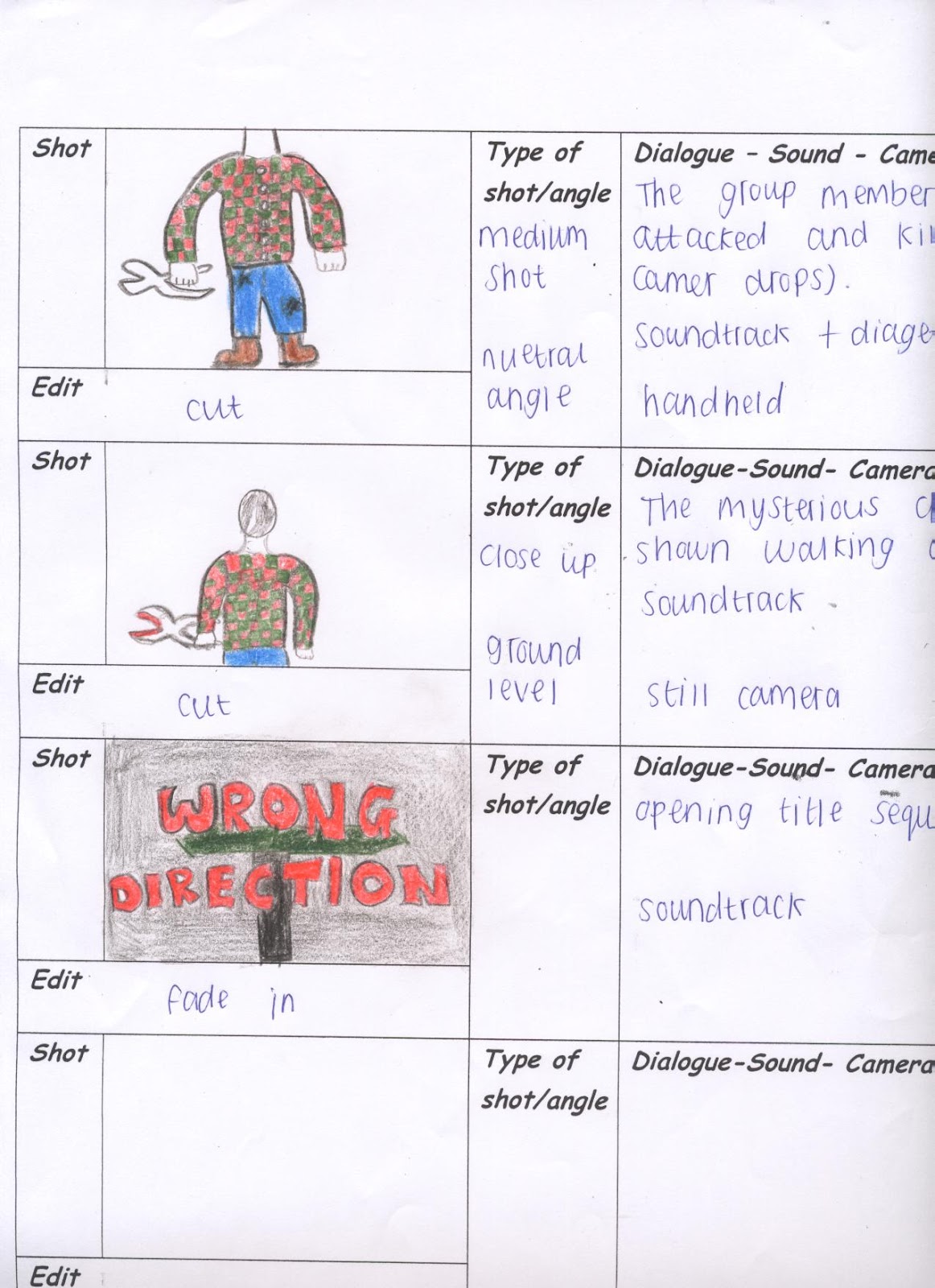
When we had drawed the pictures and coloured them we had then scanned them and then crop the images using paint, some of the images we had edited in paint to make more better quality and to add props and scenary such as a path with grass.
(picture below showing this)
When we had finshed cropping and editing the images i then made sure that every image was the same size (470x320) because when the images went from shot to shot their was a black gap between the video player and the edge of the image, I did this because i felt it may disorentate the viewer so i made the images the same size.


Making the animatic film we edited it all in a software called windows movie maker. In windows movie maker we added a video transition between each shot such as a fade, at the last shot which is the disfigured man with a unique weapon we faded that shot as that was the end of the animatic film. In our animatic film we also included video effects such as ease in or ease out which was zooming in on a shot or zooming out of a shot.
Monday, 12 December 2011
Animatic Diary Entry
The flexible learning day consisted of our group finishing our pictures on our storyboard, then we had to scan them images on to the computer and from their was had to crop each shot and also edit them in paint. When we had finish that we then had to import them into windows movie maker in which we didn't get that far due to problems and also timing as well. Our group had each job to do in which was to finish off the storyboard by colouring and also write about what camera movement and angle would be in each shot. Once we did that we had to colour the storyboard which was very time costly as it took up nearly the whole, this is why we didn't get to finish off importing the video and then add video transitions and effects. Another reason why we didn't manage to finish off was because our group was the last to use the scanner, when everyone had finish it did not leave us much time.
Their was many problems we had face before we even started which was the classroom had no power which meant that the computers would not turn on, after that was solved someone in the class had to get crayons. When we had crayons and the computers having power we had then had to get a scanner in which took about 1 hour 15 minutes up of our time as we had to wait for a IT technician. Another problem we had was when we had finish off colouring in the storyboard we had scanned all the images and we was not happy with the outcome or quality of the scanned image due to it being very light coloured, this problem was over come like many others so we had to colour it in again which then lost our place to use the scanner.
I would say that our group did well at each of our jobs as we each had a task to do and i think with the outcome we did well because we had a lot of problems much managed to over come them and get on with it.
Their was many problems we had face before we even started which was the classroom had no power which meant that the computers would not turn on, after that was solved someone in the class had to get crayons. When we had crayons and the computers having power we had then had to get a scanner in which took about 1 hour 15 minutes up of our time as we had to wait for a IT technician. Another problem we had was when we had finish off colouring in the storyboard we had scanned all the images and we was not happy with the outcome or quality of the scanned image due to it being very light coloured, this problem was over come like many others so we had to colour it in again which then lost our place to use the scanner.
I would say that our group did well at each of our jobs as we each had a task to do and i think with the outcome we did well because we had a lot of problems much managed to over come them and get on with it.
Friday, 2 December 2011
Preliminary Video
This our premlinary video consisted of lauren powell (actor) , Ryan Rheeston (actor) and Me Craig Fallows (Camera man and editor) .
This is our Preliminary video, within the video are camera techniques such as shots and angles, we had followed the 180 degree rule and also included over the shoulder shots, all of these techniques we have learnt in AS media lessons which proved effective in our preliminary video. We had recorded the preliminary video with a classroom in the school where we had used chairs and tables, we had set out the table and chairs the way we wanted so we could first practised each shot and the movement of the camera so that we had good footage to edit so we didn't have to go back and do it again. I think that the video overall was a good job we had done as a group as we had used the knowledge we learnt in lessons which was the camera angle & shots, over the shoulder shot and also the 180 degree rule. With the video techniques being used in our video I felt that the camera movements and angles was a good aspect as when you watch the video their is no shots where it disorientate the viewer, another good aspect was the camera zooming in on props as I think this was important for the viewers to know what the object is so the choice of zooming in on objects was another good aspect of our video.Within our video we had used props, one of them was a briefcase, without this I think that the video would of been very plain and dull without that props and also the viewer watching might have lost interest if we didn't have props.
Their are a lot of things we could of improved on such as people in the background talking in which I think as a group we could have stopped that from happening. The dialogue or storyline was very hard to make out and also follow what was going on in which I think it could confuse the audience as from the noise in the background it's very hard to follow. Another improvement was the props we had made, the prop was a piece of paper which was a contract but as you could see it was just scribbled pattern to make out it was writing, we could of improved this by making a contract on a computer but with the time given we would not of had enough time to film the video. Within the video could of been more talking, more dialogue to give the storyline more structure.
Thursday, 24 November 2011
Preliminary Research
Continuity Editing is the main sort of style of editing for a film, television programmes, the editing is putting scenes together. Its editing that's flows through shots smoothly without disorientating the viewer or audience so that it's smooth over the transition of the recording and that the scenes change naturally and also unnoticed. Their are two types of categories which consist of continuity editing and they are temporal and spatial cutting. These film techniques are important as the audience can understand and follow the story, the viewers would also need to understand the concepts of the story.Temporal cutting is connecting shots to narrative development, this maybe linear progression or not. Temporal cutting also consists of flash back on a characters life and also the progression of time. An example of this would be a scene where there is a house party and through out the party their would need to be a progression of time passing by.
Other than temporal cutting their is also another category within continuity editing which is spatial cutting. Spatial cutting creates unified space through the editing shots from different angles and also framing. Spatial editing also includes the rule which is the 180 degree rule when filming. The 180 degree rule involves two characters, when filming you should film on one of the characters shoulder such as their left, and the other characters right shoulder. This then creates a 180 degree, if you don't follow the 180 degree rule then you disorientate the audience. The picture below explains more in a visual way
 Here is an example (video) of how part of a film is keeping to the 180 degree rule
Shot and reverse shot is a filming technique, shot and reserve shot is where you film a character looking at another character and then reverses in which shows the other character facing each other, this is shown facing in opposite directions in which the audience thinks that the characters are facing each other.This film technique can also be used by having over the shoulder shots as the character is shown over one characters shoulder and then the other in which it can reverse. This technique may have two different camera's or maybe just one camera in the same height with it sticking the the 180 degree rule, one camera would be used for over the shoulder technique as if you had two camera's over the two characters shoulders then obviously you would see the other camera in the shot.
Here is a diagram (image) showing this


Match on action is a editing technique, it's where one shot is cut to another shot. Match cut is two different actions in different locations or objects, this draws parallels or contrast with two different time-space locations in which the transitions are smooth when linking the shots together. Here is a video below showing this.
I think that continuity editing is important when filming because it is essential as the transition between shots is as smooth as possible to ensure that the audience has maximum enjoyment and interest from the film and that no attention is drawn to the change in shot or disorientation with the shots. I think without match on action films would be boring as the shots wouldn't be natural or realistic in which this wouldn't appeal to the audience.
Bibliography:
http://www.slideshare.net/leviwigglesworth/shot-reverse-shot-and-match-on-action-media
http://www.slideshare.net/stewedveg/continuity-editing-10739140
http://www.cybercollege.com/tvp050.htm
http://www.slideshare.net/tijoum/the-180-degree-rule
Filmography: Step Brothers
Other than temporal cutting their is also another category within continuity editing which is spatial cutting. Spatial cutting creates unified space through the editing shots from different angles and also framing. Spatial editing also includes the rule which is the 180 degree rule when filming. The 180 degree rule involves two characters, when filming you should film on one of the characters shoulder such as their left, and the other characters right shoulder. This then creates a 180 degree, if you don't follow the 180 degree rule then you disorientate the audience. The picture below explains more in a visual way
Shot and reverse shot is a filming technique, shot and reserve shot is where you film a character looking at another character and then reverses in which shows the other character facing each other, this is shown facing in opposite directions in which the audience thinks that the characters are facing each other.This film technique can also be used by having over the shoulder shots as the character is shown over one characters shoulder and then the other in which it can reverse. This technique may have two different camera's or maybe just one camera in the same height with it sticking the the 180 degree rule, one camera would be used for over the shoulder technique as if you had two camera's over the two characters shoulders then obviously you would see the other camera in the shot.
Here is a diagram (image) showing this

Match on action is a editing technique, it's where one shot is cut to another shot. Match cut is two different actions in different locations or objects, this draws parallels or contrast with two different time-space locations in which the transitions are smooth when linking the shots together. Here is a video below showing this.
I think that continuity editing is important when filming because it is essential as the transition between shots is as smooth as possible to ensure that the audience has maximum enjoyment and interest from the film and that no attention is drawn to the change in shot or disorientation with the shots. I think without match on action films would be boring as the shots wouldn't be natural or realistic in which this wouldn't appeal to the audience.
Bibliography:
http://www.slideshare.net/leviwigglesworth/shot-reverse-shot-and-match-on-action-media
http://www.slideshare.net/stewedveg/continuity-editing-10739140
http://www.cybercollege.com/tvp050.htm
http://www.slideshare.net/tijoum/the-180-degree-rule
Filmography: Step Brothers
Subscribe to:
Posts (Atom)